 Ean Schuessler
46e8d9edcb
Ean Schuessler
46e8d9edcb
Critical fixes: - Set resolvedScreenDef after successful literal path resolution (was falling back to webroot) - Traverse default subscreens when looking up transitions (matching action discovery logic) - Build full path including subscreens for framework transition execution New features: - moqui_batch_operations tool for multi-step workflows - Enhanced validation error handling with field-level details - ARIA mode now includes value, ref, description, describedby attributes Documentation: - Added render modes table and examples to AGENTS.md - Updated README with MARIA format explanation - Added MCP_SERVICE_DOCS wiki space with service parameter docs |
||
|---|---|---|
| .gradle | ||
| .settings | ||
| data | ||
| entity | ||
| screen | ||
| service | ||
| src | ||
| test | ||
| .gitignore | ||
| AGENTS.md | ||
| ai-screen-theme-outline.md | ||
| build.gradle | ||
| component.xml | ||
| jina-youtube-howto.md | ||
| MoquiConf.xml | ||
| opencode.json | ||
| README.md | ||
Moqui MCP: AI Agents in the Enterprise
Give AI agents real jobs in real business systems.
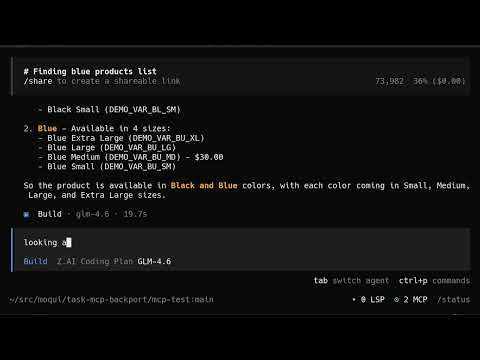
What This Is
Moqui MCP connects AI agents to Moqui Framework, an open-source ERP platform. Through MCP (Model Context Protocol), agents can browse screens, fill forms, execute transactions, and query data - the same operations humans perform through the web interface.
This isn't a chatbot bolted onto an ERP. It's AI with direct access to business operations.
What Agents Can Do
- Browse the complete application hierarchy - catalog, orders, parties, accounting
- Search products, customers, inventory with full query capabilities
- Create orders, invoices, shipments, parties, products
- Update prices, quantities, statuses, relationships
- Execute workflows spanning multiple screens and services
All operations respect Moqui's security model. Agents see only what their user account permits.
Why Moqui?
ERP systems are the operational backbone of business. They contain:
- Real data: Actual inventory levels, customer records, financial transactions
- Real processes: Order-to-cash, procure-to-pay, hire-to-retire workflows
- Real constraints: Business rules, approval chains, compliance requirements
Moqui provides all of this as open-source software with a uniquely AI-friendly architecture:
- Declarative screens: XML definitions with rich semantic metadata
- Service-oriented: Clean separation between UI and business logic
- Artifact security: Fine-grained permissions on every screen, service, and entity
- Extensible: Add AI-specific screens and services without forking
The MARIA Format
Enterprise screens are built for humans with visual context. AI agents need structured semantics. We solved this with MARIA (MCP Accessible Rich Internet Applications) - a JSON format based on W3C accessibility standards.
MARIA transforms Moqui screens into accessibility trees that LLMs naturally understand:
{
  "role": "document",
  "name": "FindParty",
  "children": [
    {
      "role": "form",
      "name": "CreatePersonForm",
      "children": [
        {"role": "textbox", "name": "First Name", "required": true},
        {"role": "textbox", "name": "Last Name", "required": true},
        {"role": "combobox", "name": "Role", "options": 140},
        {"role": "button", "name": "createPerson"}
      ]
    },
    {
      "role": "grid",
      "name": "PartyListForm",
      "rowcount": 47,
      "columns": ["ID", "Name", "Username", "Role"],
      "children": [
        {"role": "row", "name": "John Sales"},
        {"role": "row", "name": "Jane Accountant"}
      ],
      "moreRows": 45
    }
  ]
}
The insight: AI agents are a new kind of accessibility-challenged user. They can't see pixels or interpret visual layout - they need structured semantics. This is exactly the problem ARIA solved for screen readers decades ago. But ARIA has no JSON serialization, and screen readers access accessibility trees via local OS APIs, not network protocols. MARIA fills this gap: the ARIA vocabulary, serialized as JSON, transported over MCP.
Because humans and agents interact through the same semantic model, they can explain actions to each other in the same terms. "I selected 'Shipped' from the Order Status dropdown" means the same thing whether a human or an agent did it - no translation layer needed.
Why Integrated MARIA Beats Browser Automation
Tools like Playwright MCP let agents control browsers by capturing screenshots and accessibility snapshots. This works, but it's the wrong abstraction for enterprise systems:
| Aspect | Playwright/Browser | Integrated MARIA |
|---|---|---|
| Latency | Screenshot → Vision model → Action | Direct JSON-RPC round-trip |
| Token cost | Images + DOM snapshots burn tokens | Semantic-only payload |
| State access | Limited to visible DOM | Full server-side context |
| Security | Browser session = full UI access | Fine-grained artifact authorization |
| Reliability | CSS changes break selectors | Stable semantic contracts |
| Batch operations | One click at a time | Bulk actions in single call |
MARIA delivers the accessibility tree directly from the source - no browser rendering, no vision model, no DOM scraping. The agent gets exactly the semantic structure it needs with none of the overhead.
Render Modes
| Mode | Output | Use Case |
|---|---|---|
aria |
MARIA accessibility tree | Structured agent interaction |
compact |
Condensed JSON summary | Quick screen overview |
mcp |
Full semantic state | Complete metadata access |
text |
Plain text | Simple queries |
html |
Standard HTML | Debugging, human review |
Example Session
Agent: moqui_browse_screens(path="PopCommerce/PopCommerceAdmin/Catalog/Product/FindProduct")

Server: {
  "summary": "20 products. Forms: NewProductForm. Actions: createProduct",
  "grids": {"ProductsForm": {"rowCount": 20, "columns": ["ID", "Name", "Type"]}},
  "actions": {"createProduct": {"service": "create#mantle.product.Product"}}
}

Agent: I need to create a new product with variants.
       moqui_browse_screens(
         path="PopCommerce/PopCommerceAdmin/Catalog/Product/FindProduct",
         action="createProduct",
         parameters={"productName": "Widget Pro", "productTypeEnumId": "PtVirtual"}
       )

Server: {
  "result": {"status": "executed", "productId": "100042"},
  "summary": "Product created. Navigate to EditProduct to add features."
}
Getting Started
# Clone with submodules
git clone --recursive https://github.com/moqui/moqui-mcp

# Build and load demo data
./gradlew load

# Start server
./gradlew run

# MCP endpoint: http://localhost:8080/mcp
MCP Tools
| Tool | Purpose |
|---|---|
moqui_browse_screens |
Navigate screens, execute actions, render content |
moqui_search_screens |
Find screens by name |
moqui_get_screen_details |
Get field metadata, dropdown options |
Architecture
┌─────────────────┐     ┌──────────────────┐     ┌─────────────────┐
│   AI Agent      │────▶│   MCP Servlet    │────▶│  Moqui Screen   │
│                 │◀────│  (JSON-RPC 2.0)  │◀────│   Framework     │
└─────────────────┘     └──────────────────┘     └─────────────────┘
                                │
                        ┌───────┴───────┐
                        ▼               ▼
                ┌──────────────┐ ┌──────────────┐
                │    MARIA     │ │  Wiki Docs   │
                │  Transform   │ │  (Guidance)  │
                └──────────────┘ └──────────────┘
- MCP Servlet: JSON-RPC 2.0 protocol, session management, authentication
- Screen Framework: Moqui's rendering engine with MCP output mode
- MARIA Transform: Converts semantic state to accessibility tree format
- Wiki Docs: Screen-specific instructions with path inheritance
Use Cases
Autonomous Operations
- Purchasing agents negotiating with supplier catalogs
- Inventory agents reordering based on demand forecasts
- Pricing agents adjusting margins in real-time
Assisted Workflows
- Customer service agents with full order history access
- Sales agents generating quotes from live pricing
- Warehouse agents coordinating picks and shipments
Analysis & Reporting
- Financial agents querying actuals vs. budgets
- Operations agents identifying bottlenecks
- Compliance agents auditing transaction trails
Security
Production deployments should:
- Create dedicated service accounts for AI agents
- Use Moqui artifact authorization to limit permissions
- Enable comprehensive audit logging
- Consider human-in-the-loop for sensitive operations
- Start with read-only access, expand incrementally
Status
This is an active proof-of-concept. Working:
- Screen browsing and discovery
- Form submission and action execution
- MARIA/compact/MCP render modes
- Wiki documentation with inheritance
- Artifact security integration
Roadmap:
- Entity-level queries (beyond screen context)
- Service direct invocation
- Real-time notifications (ARIA live regions)
- Multi-agent coordination patterns
Contributing
Contributions welcome:
- Test coverage and edge cases
- Additional ARIA role mappings
- Performance optimization
- Documentation and examples
- Integration patterns for other MCP clients
License
Public domain under CC0 1.0 Universal plus Grant of Patent License, consistent with Moqui Framework.